
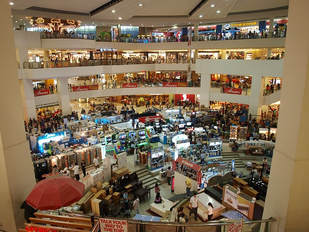
 Since the advent of on-line shopping I have been interested in its impact on in-store retail outlets. During the past ten years I have noticed two significant shifts: 1) Big Box retail outlets keep closing their doors or reducing the number of stores they operate; and 2) Small Box retail outlets are refining the customer experience.
The "click and buy" internet experience tends to be impersonal and cold, however, it is balanced with convenience and timeliness. We can purchase items, any time of the day or night, pay for them with a click, and receive them at our door step within a day or two. But, the experience lacks the social aspect of the shopping experience. That may not be important for the harried professional and time pressured young family, but it is important for those who want and need attention for a special purchase or the meet-and-greet of neighbors and acquaintances in an ever-disintegrating community fabric. Big Box Resizing The "click and buy" internet experience has had a significant impact on the "Big Box" stores. Often sheer size alone makes them less flexible to meet changing demands. In the past five years we have witnessed retail outlets that have either closed their doors or in the process of significantly reducing the number of their outlets throughout North America. Here are just a few “Big Box” stores that had strong brand power in the not too distant past and are now closed or reduced in numbers: Eatons, Sears, Radio Shack, JC Penny, Payless Shoesource, K-Mart, Zellers, Ben Moss, Danier, Guess, Chapters-Indigo, The Gap, Hudson Bay, and Macys. Who would have thought that these household retail names would disappear or find themselves in such economic straits that they need to close hundreds of stores, placing thousands of people out of work? (Read more: "over 5000 stores closed in 2017" ; "Major US Retailers Are Closing More than 6000 Stores" ; Canadian Retail Continues to Polarize as Stores Close There are several reasons why stores close their doors or downsize besides an inability to keep pace with on-line shopping. These may relate to: an inability to keep up with consumer trends; old management processes, systems and technology; a response to economic downturns within their local marketplace; and the fluctuation of taxes and the Canadian dollar. Another major factor may relate to the 'big box experience.' The 'big box experience’ is one that often overwhelms customers by the: size of the store, expansiveness of the merchandise, sparsity of customer service personnel, quality of products, pressure to push them through the payment line-up, and intrusiveness of security mechanisms. All of which take away from a ‘positive customer experience’. We do see, however, "Big Box" stores attempting to keep pace with the changing customer needs. Walmart has realized that their personnel need customer service training and improved wages. They are also gearing up to give Amazon a run at on-line shopping. I have also noticed that many of the "Big Box" stores are re-designing their expansiveness by developing specialty stores within their stores. These includes everything from coffee shops to banking outlets. They are trying to turn themselves into ‘customer convenience stores’, or a concept of a mini-mall within their store. And, most of the "Big Box" stores that have downsized are frantically trying to catch up with the "click and buy" phenomenon. The question is, is it too late for them? Small Box Refinement. What the "Big Boxes" and "click and buy" lack, the "Small Boxes" replenish. The owners and service personnel of small boxes were always close to the customer. They knew the regulars by name, their sizes, preferences, and in many instances their family members. They connected both on a social and an emotional level. They couldn't compete with the Big Box stores on price and quantity, but they could outwit them with service and quality. The "Small Box" stores are finding unique ways to draw new customers. They are combining their customer service strength with new approaches to further advance the customer experience. They are not "pushing the sale," but guiding the customer in making decisions and offering opportunities for them to test products. They are creating convenience, ambiance and activity to attract customers. They encourage, what may be called ‘encounters over the counter’, such as: special tasting times in bake shops and coffee outlets; come and go evenings to try on new clothing coupled with refreshments and meet designers and tailors; or, enjoyable conversation and a free cup of brew while you browse. Although they don’t have the selection and quantity of merchandise they do have access to the manufacturers and can bring a product in within a few days, or have it delivered to the customer's door - just like their big brother counterparts. Price may be a different matter. Often their limited purchasing power doesn’t allow them to compete on price, so they scale up on product knowledge, quality and service. Employees find a greater sense of purpose working in the "Small Boxes" because the relationships are more meaningful. They are not hired just to stock shelves. They are there to build relationships and create a "Cheers-like" culture where "Everybody knows your name." Their face-to-face encounter is further enhanced through social media and email follow-up. The result is that the employee retention rate for the "Small Boxes" is much higher and customer loyalty is strengthened when compared to the "Big Boxes". (Want to know more: Money Magazine, Kristen Behler, "The Future of Shopping" December 2017; Carl Sewell and Paul B. Brown, "Customers for Life" How to turn that One-Time Buyer into a Lifetime Customer; Darrell Rigby, Harvard Business Review, article https://hbr.org/2011/12/the-future-of-shopping Where Do Customers Really Shop? Although there is an increase in the number of people shopping on-line one recent Global study by GfK (Growth from Knowledge) found that people still want to shop in-store. The research pointed out that yes customer's felt that on-line shopping, saves money, is easier, has better selection and shopping is faster; but, in store shopping allows customers to feel and see the products before they buy, is also easier, and makes it easier to return products. The interesting finding from my perspective was that: getting information about a product or service and better pricing or saving money was about equal between the two choices for shopping. The implications for retailers are two-fold: a) "it is imperative that retailers (and their manufacturer partners) innovate to create reasons to visit, to increase propensity to buy your store, category or brand…and that retail touch points will become more important than ever." and the "second implication is that, to succeed in the future, retail needs to create synergy between on and offline, not diversity. …In future there will be less debate about on and offline, and renewed focus on the fundamentals of choice, price, convenience and experience, and how to meet and exceed shopper expectations in each and across all." Here Comes the Future Retail outlets, from my way of thinking, will always struggle to find the balance among the pressures of quality, quantity and price. "Big Box" stores often sacrifice quality in the interest of quantity and price; and "Small Box" stores sacrifice quantity and price in place of quality. Both are continuing to search for ways to attract and retain customers by providing an improved customer experience and timely service. However, today's retail businesses are not waiting for the future, for them the future has already dawned. Here are just a few examples: Drone delivery. Drone Delivery Canada has a developed a drone that can deliver goods, food, medicine, bulk mail, and emergency aid. Amazon is testing merchandise delivery via drones. Robotic service. The Japanese are experimenting with robotic service within the hotel industry, and China is experimenting with robotics in the restaurant business. 3D printing. Home grown manufacturing with 3D printing is well underway. We can now replace parts, make new objects, tools and even medical devices. Go to Youtube.com and type in 3D printing and you will be able to view several examples of the technology. Augmented Virtual Reality. With virtual reality we will be able to: try on clothing in the style and color we want without leaving our home, test drive vehicles, and purchase virtually anything we want. Facial recognition. Many countries and major outlets are now experimenting with facial recognition, not only to control fraudulent behavior but also to track customer data. This is still fraught with privacy issues, but the technology is available and being used today. Driverless Delivery trucks. Europe, United States and Canada are experimenting with driverless delivery trucks, which may shorten delivery time, reduce traffic accident deaths and put thousands of truck drivers out of business. There is still some time to go for this to happen. Some futurists see the requirement for drivers in the city, while hubs will emerge on the outside of the city where driverless trucks take over. Read more Omnichannel retailing: The name reflects the fact that retailers will be able to interact with customers through countless channels – websites, physical stores, kiosks, direct mail and catalogs, call centers, social media, mobile devices, gaming consoles, televisions, networked appliances, home services and more. Conventional merchants will need to adopt a new perspective – seamless. Read more omnichannel experience. Author: Richard P. Fontanie
0 Comments
For the past several years during the month of April, Jake and Kate land in our backyard fishpond. Kate nests near-by and Jake goes out to forage. Early in the morning and evening, during the nesting period, Kate comes back for a dip in the pond and looks for the food we put out for her. We look forward to our Spring visitors as we know Summer is just around the corner and the flowers will soon bloom. We believe our back yard has become Jake and Kate's private resort for a Spring Retreat as they prepare for their off-spring. Once the ducklings have hatched Kate trots them off to a bigger pond. Jake and Kate are only with us for a short but a very productive time.
Spring is a great time to renew your business with a Strategic Planning Retreat. A Strategic Planning Retreat is a short and productive time away from your busy place of business to look back at what your organization has accomplished over the past year and to look ahead and set new goals for the future. Here are six ingredients to prepare for a successful Strategic Planning Retreat. Be clear about its purpose A Strategic Planning Retreat is an opportunity for a business leadership team, board members, management and selected personnel to focus their energies on such areas as organizational renewal, strategic and long-range planning, values clarification, new policy directions and macro change requirements. In most instances a Strategic Planning Retreat sets the direction for change. If change is not on the agenda, then the retreat is all about continuing the "same old stuff." And, if that is the case the planners are dealing with the present and extending what the business is "doing" today into the future, rather than peering into the future and making changes to achieve higher levels of success. Clarify who is involved It is important to view a Strategic Planning Retreat as a fundamental requirement for the continued growth of the business or not-for-profit organization. It is an on-going process and not a one-time event. The leadership team must be committed to the process and dedicated to subsequently lead and manage the results of the retreat. Key people required for a retreat include: Business Owners, Board Members, Executive and Senior Managers from all departments, and, others as deemed necessary for the success of the retreat. Small organizations include most of their employees. Preparation Planning for a retreat begins several weeks and often months in advance. Tag someone with the responsibility to scan the environment for information that will impact the organization in the long term. This person scans newspapers, magazines, news bulletins, industry literature; and looks for legislative or regulatory changes, industry developments, public policy issues, changes within the marketplace, competitive and collaborative activities, research developments, and pressures within the organization. The information is collated and sent out to the attendees with the expectation that they will read it and come to the retreat prepared. Depending on the size of your organization, it is also advisable to identify: a) an internal coordinator for administrative purposes with authority to book facilities, arrange for lodging and meals, set up rooms and order special requirements; and b) someone who is an objective outsider with strong facilitative skills who will enable full participation of the attendees and guide the process to a successful conclusion. Timing The best time for a Strategic Retreat is at least two months before preparation of an annual budget. This allows the leadership team to incorporate the new initiatives and change requirements identified at the retreat into the budgeting process. If this is a first retreat, then hold it at least three months in advance of the budget planning cycle. The length of the planning retreat could last up to two and one-half days. The length of the retreat depends on the numbers in attendance, whether the retreat is a first, the size of the organization and the change issues that need to be resolved. Location Planning retreats are best held outside of the office complex. This frees those in attendance from unplanned interruptions and distractions. The location should lend itself to informality; the room set up should allow for all those in attendance to see each other, such as a horseshoe seating arrangement; and there should be opportunity for small group breakout sessions and for fresh air walks. Our best retreats are held in park settings and resorts. However, It is critically important to remember that this is not a vacation. It is a short, intensive working session that requires concerted individual and team mental effort. Requirements The attendees bring their creative intelligence and any documents circulated to them in advance to the planning session. As a back-up, the coordinator should make sure that there is at least: one copy of all materials that were sent out in advance, a copy of the previous year's planning document, an organizational chart and any other documents describing the organization and its intention. What to do Learn from Jake and Kate who annually home in on their Spring Retreat and make it a practice to renew your business with a Planning Retreat every year. It will pay dividends for you including:
Auther: Richard Fontanie MSW, FCMC Up-dated from Fontanie Learning March 1, 2018 |

Business Categories
All
Archives
March 2024

Best Product Development Program
|
 RSS Feed